



The Cotton industry’s sustainability is measured by environmental, social, and economic factors. Prilla proudly takes part in all three facets of sustainability to ensure we take part in authentically ethical practices.

At the core of what we do, Prilla always keeps ethical practices and conservation top of mind, when sourcing our raw materials, including cotton lint and yarns. As a member of the Better Cotton Initiative since 2015, we stringently adhere to the seven better cotton principles.
Virgin cotton lint is used in our ring and rotor spinning processes, some of our open end yarns are manufactured from a virgin/waste mix - the waste used in this process is generated from our internal processes. During the carding and combing process a lot of short fiber that is not suitable for ring spinning and is therefore extracted through our air filtration system and regathered at our waste plant, added into our open end mix and reused. All the waste generated from the ring spinning line is reused on the open end line. None of the material is wasted.
Some of the waste that can’t be reused, that we call hard waste (a small percentage of yarn that can’t be used due to various factors), is sold to other professional recycling companies and used for various repurpose application for example underlays i.e. felt for carpeting, sound acoustic felt etc.
Some process related waste streams that are unable to be reused internally are channelled into furniture and upholstery manufacturers for stuffing.
Our cotton arrives at our factory in large bales, most of which are covered in low density polyethylene and wire. The plastic is gathered, removed and sold to a recycling company that manufactures various recycled items including garden furniture. The wire from the bales are also recycled and used for palisade fencing as reinforcing.
Micro dust generated during the manufacturing process is removed by waste management experts, EnviroServ and disposed of. Other materials that make up our waste, including some of the recycled cotton we are unable to use, are also utilised by furniture companies for upholstery and stuffing.
Throughout our premises we make use of motion detection LED lighting to reduce consumption of electricity and we are currently exploring introducing Photovoltaic Panels.
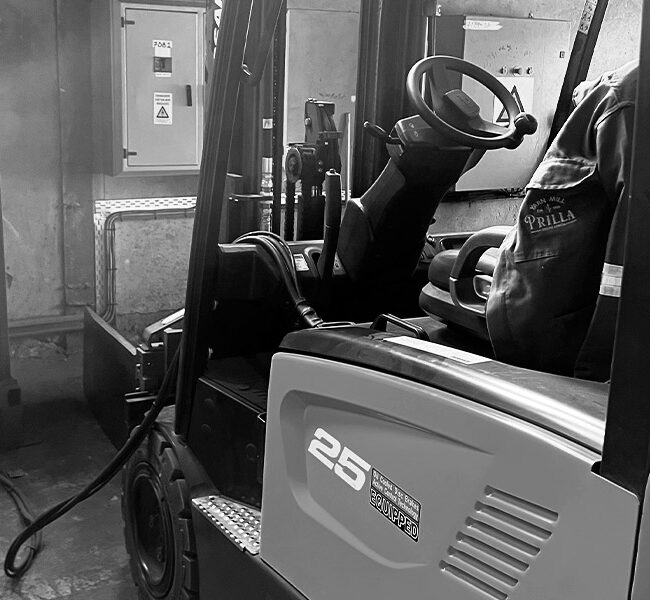
We also make use of smart metering to monitor consumption and variations. This metering enables us to manage and update the reticulation network, which is being modernised to reduce energy wastage. Our warehouse has zero gas emissions because all our Forklifts are battery operated.

During the dyeing process, many textile mills consume a considerable amount of water, which does not contribute to the sustainability of the environment. Prilla is a“dry mill”, which means no effluent or water is used during our manufacturing process.
The only water used in our plant is for ablution facilities and we are currently investigating rain water harvesting to further our efforts.

At Prilla we care about our people. Our staff are our biggest asset and therefore we ensure that they receive all the support they need to stay healthy. We employ a full time occupational nurse on our premises and we have a dedicated medical doctor that does regular visits to help us care for our staff. We also host regular health and wellness days to assist and guide our staff to make healthy lifestyle choices.
Training and skills development is important to us at Prilla and we employ two full time facilitators to oversee our skills development and learnership programme. Our programme teaches students the different skills and techniques required to manufacture yarn.
We also believe in making an impact in our local community and therefore host regular inspirational talks at our local schools as part of our social responsibility initiative.

We support the economic development of our internal suppliers. On premises, we have a catering company that we support financially along with day to day operational requirements and ongoing training to assist this entrepreneur to continue to grow her business. We have also partnered and host a SMMEE transport service that operates from our premises, free of charge. These initiatives empower our staff and community.
To date, Prilla also supports approximately 1000 individual subsistence farmers. We believe in empowering and uplifting communities by supporting small businesses. Locally we purchase from two cotton gins, namely The Makhathini Gin, based near the Swaziland and Mozambique border near Jozini, and the Limpopo Valley Gin, based in Mpumalanga.
The Makhatini Gin does not only have their own commercial farm but also support over 600 individual farmers who sell to them daily. The Limpopo Valley Gin supports over 400 individual farmers.
The small farmer gets remuneration from these local gins that afford them to grow a new crop, and so the cycle can be repeated and in turn encourage others to plant more cotton.
We are B-BBEE Compliant
The Broad-Based Black Economic Empowerment program aims to transform SA’s economy by enhancing economic participation.

